Verdict: the heated system wins over 20 years, and the payback is 9.2 years, not 2
Adding electric snow melt to a 20 x 20 ft driveway costs about $5,461 beyond pouring the same slab unheated: $2,362 of 240 V tire-track mats, $599 for the controller and sensor, $1,500 for the licensed electrician's panel integration and conduit, and $1,000 of incremental paving labour to tie the mats to mesh and keep them elevated. It then costs $57.60 a season at 16¢/kWh. The unheated driveway it displaces forgoes roughly $650 a year of plowing, salt and patch work. That makes the maintenance-only payback $5,461 divided by $592.40, or 9.2 years. Published material that quotes a 2-year payback is not reproducing this arithmetic.
The upfront premium, line by line
| Line item | Unheated baseline | Heated, tire tracks, 20 x 20 ft | Note |
|---|---|---|---|
| Heating elements | - | $2,362 | 240 V tire-track mats, two 2 ft paths, 80 sq ft heated |
| Controller and sensor | - | $599 | Value-tier automatic controller with sensor |
| Electrician: panel integration and conduit | - | $1,500 | GFEP breakers and low-voltage conduit separation |
| Incremental paving labour | - | $1,000 | Tying mats to mesh and elevating them through the pour |
| Concrete paving | $8,000 | $8,000 | Same 4 in. winter mix either way |
| Total | $8,000 | $13,461 | Premium $5,461 |
Two context figures keep the premium in proportion. Broom-finish concrete paving runs $6 to $10 per sq ft in the calculator's 2026 base rates, and full-coverage heating elements on the same 400 sq ft slab start near $4,750 rather than $2,362 - so choosing tire tracks roughly halves the element cost. Heating-system installation itself is quoted at $8 to $25 per sq ft in the reference ledger, which is why the same-slab framing matters: you are paying for elements and electrical work, not for a second excavation.
What it costs to run, per storm and per season
Tire tracks heat 80 sq ft of a 400 sq ft driveway: two 2-foot-wide paths 20 feet long. At 50 W/sq ft that is 4,000 W, or 4 kW, drawing $0.64 an hour at 16¢/kWh. With the recommended 3-hour after-run to evaporate residual meltwater, a 6-hour storm costs $5.76. Ten such storms cost $57.60.
| Storm duration | Running time with 3 h after-run | Cost, 80 sq ft tire tracks (4 kW) | Cost, 400 sq ft full coverage (20 kW) |
|---|---|---|---|
| 1 hour | 4 h | $2.56 | $12.80 |
| 3 hours | 6 h | $3.84 | $19.20 |
| 6 hours (average) | 9 h | $5.76 | $28.80 |
| 9 hours (severe) | 12 h | $7.68 | $38.40 |
| 12 hours (blizzard) | 15 h | $9.60 | $48.00 |
Full coverage costs five times as much to run as tire tracks on the same slab - $288 a season against $57.60 - and it will not fit most residential services under the 40%-of-panel rule, which the electrical load article works through. If the number of plowable storms in your part of Central Indiana differs from the calculator's default of 10, scale directly: the seasonal figure is linear in storm count.
The year-12 cliff is what actually settles the argument
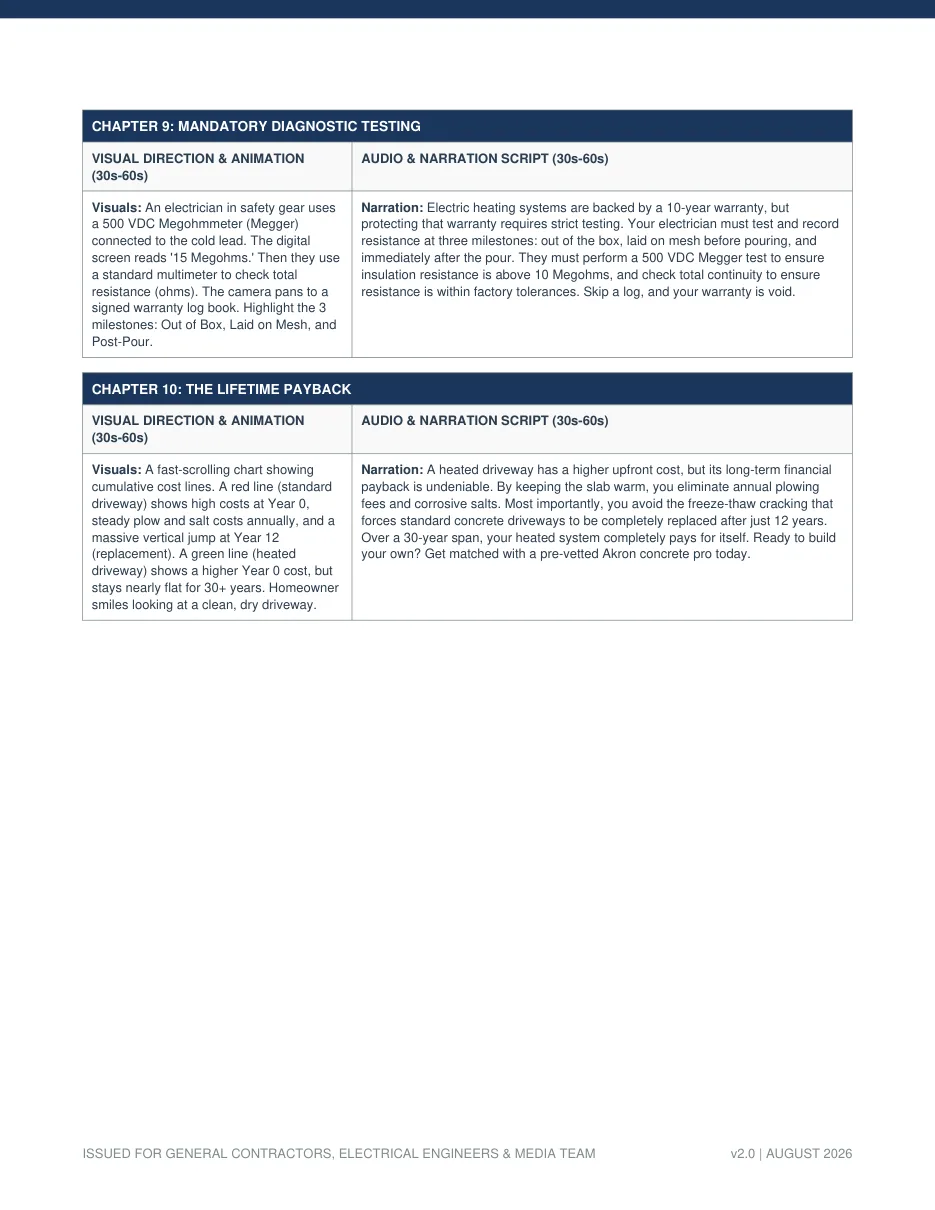
An unheated driveway is not a fixed $8,000. In harsh winter climates, standard concrete takes severe structural damage from freeze-thaw cycles, corrosive road salt and abrasive plow blades. Year 12 is the statistical midpoint of that failure window, at which point the driveway is typically at full tear-out, excavation and replacement - $4,000 to $12,000. A heated slab, held above freezing all winter, avoids the freeze-thaw stress entirely and keeps its surface away from salt and plow blades.
| Year | Heated cumulative | Unheated cumulative | What is happening |
|---|---|---|---|
| Year 0 | $13,461 | $8,000 | Heated starts $5,461 behind |
| Year 9 | $13,979 | $13,850 | Maintenance-only crossover |
| Year 12 | $14,152 | $21,800 | Unheated driveway fails and is replaced |
| Year 20 | $14,613 | $29,000 | $14,387 gap favouring the heated slab |
The $650 annual unheated baseline is the source of the recurring figures: $450 for a seasonal professional plowing contract, $50 for de-icing salt and chemicals, and $150 of amortised crack sealing and surface repairs to manage freeze-thaw pitting. Professional plowing averages $25 to $75 an hour, or about $450 for the season.
The honest payback, stated three ways
- Maintenance only: $5,461 divided by $592.40 = 9.2 years. A 2-year figure only appears when the heating elements go in during new construction, where the reference estimate puts the incremental element saving at $3,000 to $5,000.
- Including the year-12 replacement: the heated curve is cheaper from year 12 onward, because the unheated curve takes an $8,000 step the heated curve never takes.
- The 30-year statement: the production script's summary is that standard driveways are replaced after about 12 years and that over a 30-year span a heated system pays for itself. The annual ledger above is what makes that claim checkable rather than rhetorical.
Where the model is weakest
Three assumptions carry the result, and each can move. The $650 baseline assumes you actually pay for seasonal plowing - a household that shovels its own driveway has no $450 to avoid. The 10-storm season is the calculator's default, so a mild winter with four storms cuts the running cost by more than half and a hard winter with 15 raises it. And the year-12 replacement is a midpoint, not a schedule: a fiber-reinforced, 6% air-entrained slab on a proper compacted base will run longer, while a plain 3,000 psi mix without air entrainment will fail sooner.
Recalibrating the ledger to Indiana's snow and power prices
Two inputs in the ledger are local rather than fixed, and both have moved. The first is the electricity rate: the calculator defaults to 16 cents per kilowatt-hour, while Indiana's residential average was 17.51 cents in June 2026, up from 16.48 cents a year earlier. Applied to the same season - ten storms, six hours of melt plus a three-hour after-run - tire tracks move from $57.60 to $63.04, and full coverage on the same 400 sq ft slab from $288 to $315.18. The second is the season itself: 25.5 inches of snow under the 1991-2020 Indianapolis normals, split 6.4 inches in December, 8.8 in January, 6.0 in February and 3.2 in March. Spread across the calculator's ten-storm default that is 2.55 inches per event, which a correctly spaced system clears inside its design rate; a 15-storm winter raises tire-track energy to $94.55.
The payback moves by a tenth of a year, not by years. At 17.51 cents the annual saving falls from $592.40 to $586.96, so the maintenance-only payback on the $5,461 premium is 9.3 years rather than 9.2. Across 30 years the higher rate adds about $163 of running cost and changes nothing about the ranking, because the unheated curve's step changes are an order of magnitude larger than the energy line.
| Electricity rate | Tire tracks, 10-storm season (360 kWh) | Full coverage, 400 sq ft (1,800 kWh) | Annual saving vs $650 unheated | Maintenance-only payback on $5,461 |
|---|---|---|---|---|
| 16.00¢ (calculator default) | $57.60 | $288.00 | $592.40 | 9.2 yr |
| 17.51¢ (Indiana, June 2026) | $63.04 | $315.18 | $586.96 | 9.3 yr |
| 19.00¢ | $68.40 | $342.00 | $581.60 | 9.4 yr |
| 21.00¢ | $75.60 | $378.00 | $574.40 | 9.5 yr |
Read that table as a range rather than a prediction. Every column keeps the same $5,461 premium, the same ten-storm season and the same $650 unheated baseline, and the payback still lands between 9.2 and 9.5 years across a 16 to 21 cent span of power prices. That is the useful finding: the decision is insensitive to the thing homeowners worry about, the energy bill, and very sensitive to the thing they discount, the year-12 replacement. One consequence is worth stating plainly. A household that shovels its own driveway and never pays the $450 plowing line has no maintenance saving at all, and for that household the heated slab is bought for convenience, for a dry surface in February, and for adding years to the pavement - not for payback.
Run your own numbers
Every figure above rests on the site's own constants: 50 W/sq ft, 16¢/kWh, a 6-hour storm plus a 3-hour after-run, 10 storms a season, and the $5,461 premium. Change the electricity rate or the storm count in the calculators and the payback moves predictably, because the maintenance-only payback scales almost exactly inversely with the annual savings.
Sources
The upfront line items ($2,362 tire-track mats, $599 controller, $1,500 electrician, $1,000 incremental paving labour, the $8,000 concrete baseline and the resulting $5,461 premium), the $650 annual unheated baseline ($450 plowing, $50 salt, $150 amortised repairs), the $57.60 seasonal running cost, the $14,613-versus-$29,000 twenty-year totals with the $14,387 net saving, the year-12 failure midpoint and the $4,000-to-$12,000 replacement range, and the 30-to-50-year cable lifespan all come from the concrete notebook's Modern Driveway Blueprint and Concrete Quiz content blueprints, which are costed on a reference-market baseline. The 50 W/sq ft density, the 16¢/kWh default rate, tire-track geometry, the 6-hour storm plus 3-hour after-run convention, the 10-storms-per-season default, the $6-to-$10 per sq ft broom finish rate, the $8-to-$25 per sq ft heated installation range and the $25-to-$75 per hour plowing rate are from the Concrete Paving & Driveway Calculator Development Prompts behind /indianapolis-concrete-driveways-tools-calculators/. Per-storm and per-season costs are recomputed here from those constants; the commonly quoted 2-year payback does not reproduce from the notebook's own numbers and is not used. The year-by-year cumulative table is arithmetic on the ledgers above, rounded to the nearest dollar. Local labour, energy and plowing rates in Marion County will differ from the reference-market baseline - treat the dollar figures as a model and the ratios as the transferable part. The rate sensitivity table applies this site's own calculator constants (50 W per sq ft, ten storms, six hours of melt plus a three-hour after-run, 360 kWh for tire tracks and 1,800 kWh for full coverage on a 400 sq ft slab) to the U.S. Energy Information Administration Electric Power Monthly table 5.6.A for June 2026, where the Indiana residential average was 17.51 cents per kWh against 16.48 cents a year earlier. The 25.5-inch seasonal snowfall, its monthly split and the first and last one-inch snow dates are the National Weather Service Indianapolis 1991-2020 climate normals. The $650 unheated baseline, the $5,461 premium and the year-12 replacement midpoint remain the reference ledger figures already cited above.