Verdict: for a typical Indianapolis two-car slab, electric wins on both install and service
An electric system on a 20 x 20 ft Indianapolis driveway draws 4 kW as tire tracks or 20 kW full coverage, costs $0.64 to $3.20 an hour at 16¢/kWh, and requires no annual servicing. A hydronic system circulates glycol-water through PEX tubing from a boiler: more capital, $150 to $400 a year in maintenance, and an advantage only on large heated footprints where cheap natural gas beats electric resistance heat. Below roughly 700 heated square feet, the electric cable system is the lower-cost system to own in Marion County.
What is actually buried under the slab
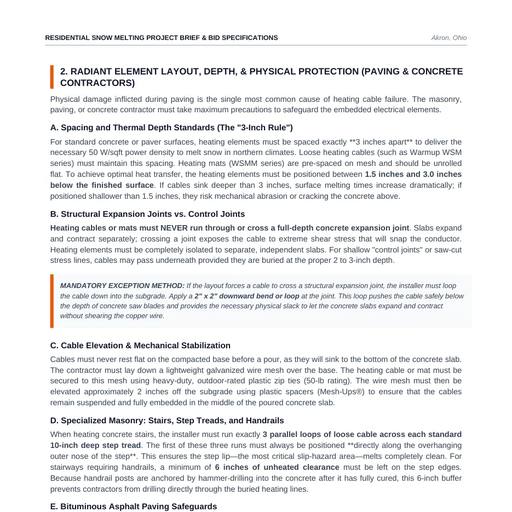
The niche's snow-melting bid specification allows two element types in concrete: electric twin-conductor heating cables in a loose WSM-series format, or pre-spaced WSMM mesh mats. Both deliver 50 watts per square foot of heated area at 240 V, buried 1.5 to 3.0 inches below the finished surface. A hydronic system swaps that cable for a boiler, pump, manifold and flexible PEX tubing carrying a glycol-water mix. It is a well-established technology; it simply adds moving parts and fluid to a slab that is already fighting Indiana's clay subgrade and freeze-thaw cycling.
| Element | Electric cable and mats (WSM, WSMM) | Hydronic PEX |
|---|---|---|
| Buried component | Twin-conductor resistance cable at 3 in. spacing, zip-tied to galvanised wire mesh | PEX tubing loops carrying glycol-water, plus boiler, pump and manifold |
| Design output | 50 W/sq ft at 240 V (38 W/sq ft where loose cable is laid at 4 in. spacing) | Boiler rated in BTU/hr, supply temperature set by outdoor reset |
| Sensing and control | Forecast-based Wi-Fi controller, aerial snow switch, in-slab limit sensor | Outdoor sensor, boiler aquastat, zone valves and circulation pumps |
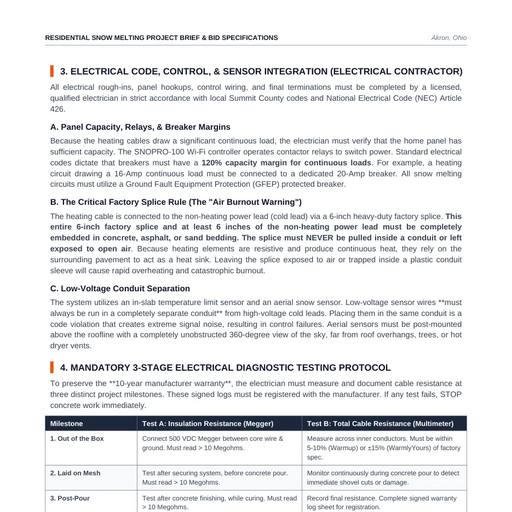
| Services needed in the house | Dedicated GFEP double-pole breakers; 40 A maximum continuous per branch circuit | Gas or propane supply and a flue, plus pump wiring and glycol fill |
The single most expensive electric error is also the easiest to describe: the 6-inch factory hot-to-cold splice is an active part of the resistive line and must be fully embedded in concrete, asphalt or sand bedding, where the pavement acts as a heat sink. Pulled inside a wall conduit to keep it clean, it overheats and burns out in minutes. Hydronic systems have no splice to bury, but they do have a boiler to flue and a fluid loop that can leak under a cured slab.
What it costs to run, and how Indianapolis storm counts change it
The energy arithmetic is fixed by the constants in this site's own calculator: 50 W/sq ft, 240 V, 16¢/kWh, and the recommended 3-hour after-run that evaporates residual meltwater so it cannot refreeze. Only the number of plowable storms per season is local, and that is the one number a homeowner can actually check.
| Layout | Heated area | Draw | Per hour | Per 6 h storm + 3 h after-run | Season at 10 storms |
|---|---|---|---|---|---|
| 20 x 20 ft full coverage | 400 sq ft | 20 kW | $3.20 | $28.80 | $288.00 |
| 20 x 20 ft tire tracks | 80 sq ft | 4 kW | $0.64 | $5.76 | $57.60 |
| 30 x 20 ft full coverage | 600 sq ft | 30 kW | $4.80 | $43.20 | $432.00 |
| 10 x 20 ft walkway approach | 200 sq ft | 10 kW | $1.60 | $14.40 | $144.00 |
| Plowable storms in a season | Tire tracks, 80 sq ft (4 kW) | Full coverage, 400 sq ft (20 kW) | Walkway, 200 sq ft (10 kW) |
|---|---|---|---|
| 4 storms (mild winter) | $23.04 | $115.20 | $57.60 |
| 6 storms | $34.56 | $172.80 | $86.40 |
| 10 storms (calculator default) | $57.60 | $288.00 | $144.00 |
| 15 storms (hard winter) | $86.40 | $432.00 | $216.00 |
Tire tracks are two parallel 2-foot-wide tyre paths. On a 20 x 20 ft slab they reduce heated area by 80%, and the element cost and seasonal energy fall by the same proportion. The limit is honest: only the tyre paths clear. Full coverage on the same slab costs five times as much to run and, as the electrical load article shows, it will not fit a 200-amp service under the 40%-of-panel rule.
Maintenance, lifespan and repair
| Metric | Electric | Hydronic |
|---|---|---|
| Annual maintenance | $0 - no scheduled servicing | $150-$400/yr for boiler service, pump checks and glycol pH testing |
| Operating lifespan | Cables rated 30-50 years, outlasting the pavement | PEX 20-30 years; boiler 15-20 years |
| Repair method | Locate a single break with thermal imaging and signal-travel testing, then splice | Trace and repair a pressurised fluid leak beneath a cured slab |
| Slab requirement | 4 in. min., fiber-reinforced, 6% air-entrained over a 10 in. compacted base | Same slab specification, plus a flue and gas line |
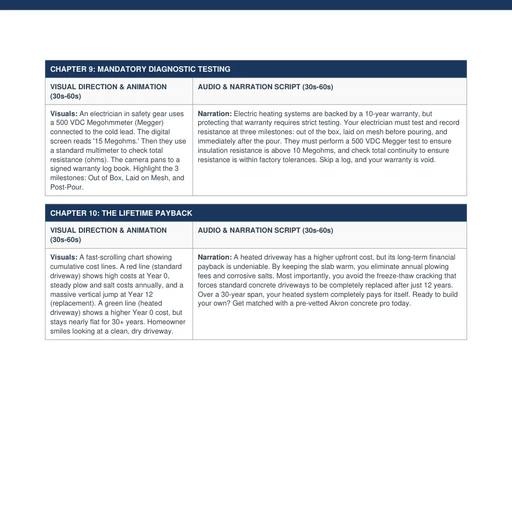
| Warranty condition | Signed three-stage resistance test log registers the 10-year cable warranty | Boiler and tubing warranties, plus service records |
The service line is the deciding factor for most homeowners. A hydronic system requires an annual visit from someone qualified to open the boiler and test glycol chemistry; an electric system asks for nothing until something breaks. When a cable does fail, the diagnostic path - thermal imaging plus a signal-travel test to pinpoint a single break - is a repair, not a re-pour.
Fuel arithmetic on Indiana prices, not national averages
The case for hydronic rests on cheap gas, so it is worth running with Indiana's own numbers rather than a national average. Indiana residential electricity averaged 17.51 cents per kilowatt-hour in June 2026, against 16.48 cents a year earlier, and residential natural gas through the 2025-26 winter ran roughly $10 to $11.50 per thousand cubic feet, which is about $1.00 per therm. Electric resistance heat is effectively 100 percent efficient at the element, so the tire-track season already calculated - 360 kWh across ten six-hour storms plus the three-hour after-run - costs $63.04 at 17.51 cents.
Move that same heat load to a gas boiler running at 90 percent annual fuel utilisation efficiency. Because 360 kWh is 1.23 million BTU, the boiler has to fire about 1.37 million BTU of gas, or 13.7 therms. At $1.00 a therm the fuel bill is roughly $13.70 a season: about 4.6 times cheaper, and a saving of $49 a season on tire tracks. Set that against the maintenance column, where hydronic runs $150 to $400 a year for boiler service, pump checks and glycol testing and electric runs $0. The hydronic system is $100 to $350 a year worse on service alone, before any capital difference, and the fuel saving only pays that back on a much larger heated footprint.
Stated as a break-even rather than a rule of thumb: the fuel saving is about 62 cents per heated square foot per season, so $150 of annual maintenance needs roughly 240 heated sq ft to be covered and $400 needs roughly 650. Both figures count fuel only, with no allowance for the boiler, pump, manifold and PEX that hydronic adds up front, which is why the practical crossover for a Marion County driveway sits above 700 heated sq ft and moves further out if the boiler is oversized for a duty cycle that only runs a few dozen hours a year. Below that line electric is not merely simpler to install; it is cheaper to own.
One local variable does not separate the two. Indiana classifies all 92 counties as a severe weathering region, and Marion County carries a 20 psf ground snow load and a 30-inch frost depth. Both element types sit in the same slab over the same clay till, so both depend on the same 6 percent air-entrained mix, the same compacted base and the same geotextile. The heat source is not the weak link in either design; the pavement is.
Choose electric if, choose hydronic if
- Choose electric if the heated area is under about 700 sq ft, if the garage has no gas service, if you want no annual service contract, or if you are heating tyre tracks rather than the entire apron.
- Choose hydronic if heated area exceeds roughly 1,000 sq ft, if the driveway is long with a large heated footprint, or if a gas boiler already serves the property and the added capacity is incremental.
- Fix the slab first either way if the bid says 3,000 psi gravel mix with no air entrainment. In a freeze-thaw climate that mix cracks and spalls in 10 to 15 years, and it will take the heating cable down with it.
Spec handoff for the Indianapolis bid
- Element type and spacing: WSM cable or WSMM mats at 3 in. spacing, 50 W/sq ft of heated area, 240 V.
- Depth 1.5 to 3.0 in. below the finished surface, suspended on galvanised wire mesh elevated about 2 in. off the base.
- Slab: 4 in. minimum, fiber-reinforced, 6% air-entrained, over a 10 in. compacted base at 98% standard Proctor density (ASTM D 698), geotextile over clay subgrade - the standard case in Marion County.
- No cable crosses a full-depth expansion joint; where a crossing is unavoidable, a 2 in. x 2 in. downward slack loop into the subgrade.
- Forecast-based controller with an above-roofline aerial snow switch and an in-slab limit sensor; low-voltage sensor wire in its own conduit.
- Three-stage test log - 500 VDC Megger above 10 megohms and ohms within manufacturer tolerance, out of the box, laid on mesh, and post-pour.

Sources
Engineering figures are from the Residential Snow Melting Project Brief & Bid Specifications (v2.0, August 2026) published at /media/concrete-driveways/pdfs/heated-driveway-contractor-brief.pdf: 50 W/sq ft at 240 V, WSM/WSMM element types, the 3-inch spacing rule, the 1.5 to 3.0 inch depth window, 6% air entrainment, the 10-inch compacted base, 98% Proctor compaction, the splice burial rule, GFEP breakers and the 120% continuous-load margin. The 1-to-3-inch hourly melt rate, the 9% freeze expansion and the layered cross-section are from the Anatomy of a Heated Driveway production script at /media/concrete-driveways/slides/. Running costs were computed from the constants in the Concrete Paving & Driveway Calculator Development Prompts (50 W/sq ft, 16¢/kWh, 6-hour storm plus 3-hour after-run, 10 storms per season) behind this site's calculators. Hydronic maintenance, lifespan and repair comparisons, and the 30-to-50-year cable rating, are from the concrete notebook's Modern Driveway Blueprint and Concrete Quiz content blueprints. The reference brief was authored for a severe freeze-thaw Ohio siting profile with 47 in. average seasonal snowfall; the electrical and thermal constants are not climate-specific, but local snowfall and storm counts differ from the reference profile's, so the storm-count table above is presented as a sensitivity range rather than a local prediction. The fuel comparison uses the U.S. Energy Information Administration Electric Power Monthly table 5.6.A for June 2026 (Indiana residential average 17.51 cents per kWh, against 16.48 cents in June 2025) and the EIA Indiana natural gas price series for the 2025-26 winter (about $10 to $11.50 per thousand cubic feet, or roughly $1.00 per therm). The 90 percent boiler efficiency, the 100,000 BTU per therm conversion and the 3,412 BTU per kWh conversion are standard engineering constants, and the break-even areas are derived from them and labelled as arithmetic. The Marion County 30-inch frost depth, 20 psf ground snow load and Severe weathering classification are from the 2020 Indiana Residential Code climatic design criteria (675 IAC 14-4.4-5, Table R301.2(1)).